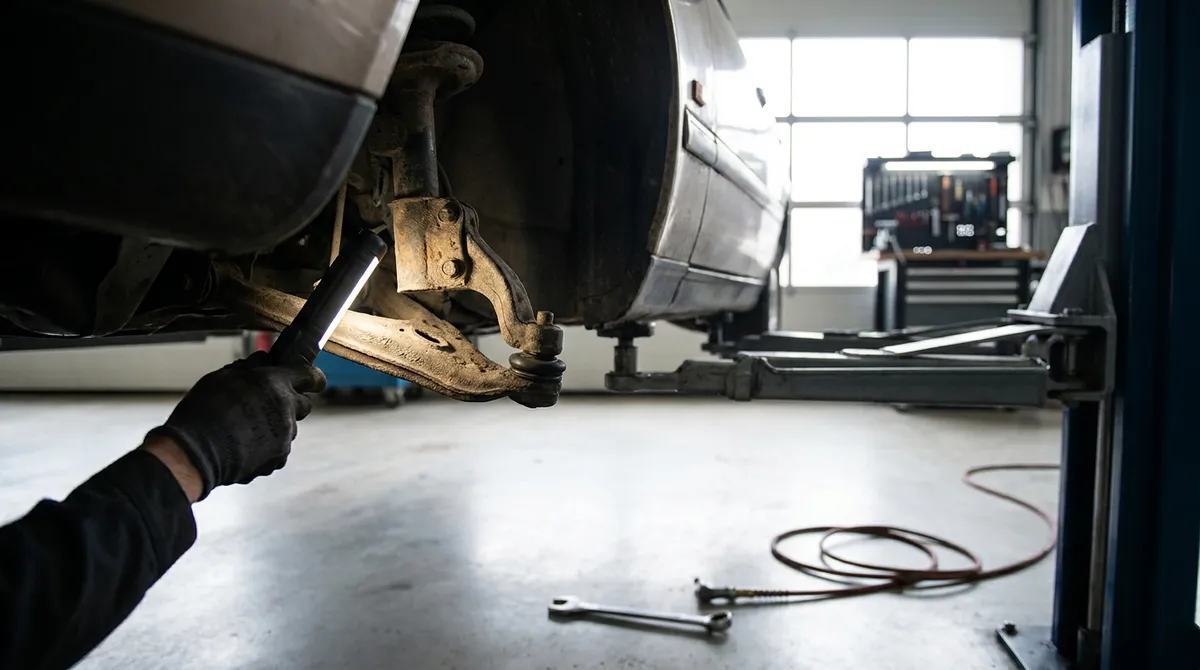
What Causes a Clunk Over Bumps?
Most clunking noises occur because a suspension or steering component has developed excessive movement. Instead of holding the suspension firmly in position, worn parts allow metal components to shift or strike each other whenever the suspension compresses over bumps.
Determining whether the noise comes from the front or rear of the vehicle—and whether it happens over small bumps, large bumps, while turning, or while braking—helps narrow down the source of the noise.
Which Best Matches Your Vehicle?
Select the Suspension Noise
Choose the condition that best matches your vehicle.
Select one of the suspension conditions above.
What Causes Clunking Over Bumps?
Worn Sway Bar Links
One of the most common causes of suspension clunks over bumps. Loose links allow the stabilizer bar to move excessively.
Ball Joint Wear
Loose ball joints may produce clunking during suspension travel and can eventually affect steering safety.
Control Arm Bushings
Worn bushings allow excessive movement and metal-to-metal contact over bumps.
Worn Strut Mounts
Damaged upper strut mounts often create clunks whenever the suspension compresses.
Worn Shocks & Struts
Weak dampers allow excessive suspension movement that may produce knocking or clunking noises.
Loose Tie Rod Ends
Steering linkage wear may create suspension noises while also affecting steering precision.
Loose Brake Components
Brake calipers, hardware, or pads can occasionally shift and create a clunk over bumps.
Loose Exhaust Components
Exhaust hangers or shields may strike nearby components during suspension movement.
Wheel Bearing Wear
Advanced wheel bearing wear may contribute to suspension noise and instability.
Impact Damage
Hitting potholes or curbs can damage suspension components, creating clunks that become worse over time.
The Driving Situation Helps Narrow Down the Cause
Only Over Bumps
Sway bar links, strut mounts, shocks, bushings, or loose suspension hardware are common causes.
While Turning
Ball joints, tie rods, sway bar links, or steering components may be worn or loose.
After a Pothole
Bent suspension parts, damaged struts, loose steering components, or wheel alignment changes should be inspected.
The Type of Noise Can Help Identify the Problem
Clunk Over Bumps
A solid clunk usually points to excessive movement in a sway bar link, ball joint, control arm bushing, strut mount, tie rod, or another suspension component.
Rattle Over Small Bumps
A lighter rattling sound may come from loose sway bar links, brake hardware, exhaust shields, underbody panels, or other components with minor free movement.
Knock During Suspension Travel
A deeper knocking sound may indicate worn shocks or struts, damaged mounts, suspension bottoming, loose hardware, or a component contacting the body or frame.
Safety Depends on the Source and Severity of the Noise
Occasional Light Clunk
A minor noise over rough pavement may not require immediate towing, but the suspension should be inspected before the worn component develops additional movement.
Frequent or Increasing Clunk
Repeated clunking may indicate worsening suspension or steering wear. Continued driving can affect alignment, tire wear, handling, and nearby components.
Clunk With Loose or Unstable Handling
Stop driving if the vehicle wanders, pulls sharply, feels loose, sits unevenly, or becomes difficult to control. A steering or suspension component may be severely worn or damaged.
Stop Driving and Seek Service If:
How We Diagnose a Clunk Over Bumps
Road Test
We reproduce the noise over controlled road surfaces and note whether it comes from the front, rear, left, or right side of the vehicle.
Visual Suspension Inspection
Shocks, struts, springs, mounts, sway bars, control arms, bushings, ball joints, and related hardware are checked for damage, looseness, or fluid leakage.
Steering Component Check
Inner and outer tie rods, steering rack mounts, steering knuckles, and related linkage are inspected for excessive play.
Loaded Movement Test
Suspension components are checked under load to identify movement that may not be visible when the vehicle is simply raised on a lift.
Brake, Exhaust & Underbody Check
Brake hardware, exhaust hangers, heat shields, splash panels, and underbody components are checked for movement that can mimic a suspension clunk.
Repair Verification
After the damaged or worn component is repaired, we road test the vehicle again to confirm the clunk is gone and handling is stable.